Featured Project

Universal Design for Learning & Disability-Specific Interventions in the K-12 Setting

This professional development course for K-12 educators is designed to bridge the gap between students’ diverse needs and teachers’ knowledge of how to address them, based on an action-research plan that revealed a significant discrepancy in this area. Focusing on Universal Design for Learning (UDL) principles and disability-specific interventions, this course provides teachers with practical strategies to create inclusive, flexible learning environments that support all students, including those with Learning Disabilities, Autism, ADHD, and more. Participants will learn how to apply UDL to engage students in multiple ways, implement targeted interventions for students with specific disabilities, and use data-driven practices to assess and adjust their instruction. This course equips educators with the tools to foster equity and inclusion, ultimately ensuring that every student has access to meaningful, personalized learning experiences.

Audience
This Professional Development course is for all teachers in the K-12 setting seeking to increase their knowledge of Universal Design principles and Disability-Specific interventions for their students.

Responsibilities
-
Curriculum Development
-
Course Mapping
-
Graphic Design
-
Game Production

Tools Used
-
Articulate Storyline
-
Canvas LMS
-
EdPuzzle
-
Canva
-
Adobe Premiere Pro
-
Adobe Illustrator
-
Google Suite
Action Research
Problem Statement:
General education instructors report substantial difficulties operationalizing IEP-mandated accommodations and modifications due to deficits in legislative awareness, intervention methodologies, and co-teaching praxis. This lack of alignment jeopardizes compliance with Free Appropriate Public Education (FAPE) requirements within the Least Restrictive Environment (LRE).
Solution:
An 8-week, UDL-centered professional development series designed to bridge the gap between "legal paperwork" and "instructional practice." By combining asynchronous learning with collaborative frameworks, this intervention equips educators with the tools to seamlessly integrate individualized supports into the general education curriculum.
Course & Curriculum Mapping
Learning Theory and Application
The course leverages Social Constructivism as its foundational learning theory. This framework emphasizes meaningful activity through collaborative knowledge construction, problem-solving, and leveraging prior experiences. Social Constructivism aligns seamlessly with the course content, which requires higher-order thinking, reflective discussion, and the application of disability-specific strategies in real-world classroom contexts.
Learning Theory Rationale
Social Constructivism is particularly suited for this course because it supports the collaborative and practical nature of differentiating instruction for diverse learners. Teachers engage in reflective discussions and draw on shared experiences, which mirrors the collaborative processes inherent in applying Universal Design for Learning (UDL) principles and tailoring disability-specific interventions.
Instructional Design Methodology
The course design is guided by Gagné's Nine Events of Instruction and supplemented by the ARCS Motivational Model:
1. Gagné's Nine Events provide a detailed roadmap for instructional delivery, from gaining attention to assessing performance and enhancing retention.
2. The ARCS Model ensures motivation by focusing on attention, relevance, confidence, and satisfaction, ensuring that participants are engaged throughout the learning experience.
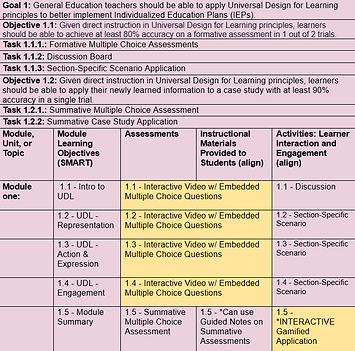
This map blends interactive video scaffolding with gamified summative assessments to drive long-term retention. By pairing collaborative discussion boards with continuous feedback loops, the design fosters an immersive, community-driven experience where learners move from passive observers to active, autonomous expert
Storyboarding
Storyboarding the game I created for the course was crucial for visualizing the user experience, clarifying the learning objectives, and ensuring a smooth, logical flow. By mapping out different classroom scenarios, such as adapting lessons for students with disabilities, the storyboard allowed me to align the game mechanics with UDL strategies to achieve the desired learning outcomes. It also helped me anticipate potential issues, refine pacing, and ensure that the game was both engaging and educational. Overall, storyboarding provided a clear roadmap for me to follow, guiding the development process and ensuring the game effectively teaches teachers how to meet the diverse needs of their students.


Course Building
This video provides a comprehensive tour of a course designed and developed using the Canvas learning management system. The walkthrough covers the course’s structure, focusing on how content is organized to enhance learner engagement, facilitate knowledge retention, and support active learning. Key elements such as interactive learning activities, assessments, and multimedia resources are highlighted to demonstrate how they align with instructional design principles. The video also explores the navigation features, ensuring that learners can easily access course materials and track their progress. Whether you’re familiar with the course or new to it, this video will guide you through the platform’s features and functionalities.
Gamification
This video explains the process behind designing the game for Module 1's application, focusing on how gamification strategies were used to enhance engagement and learning outcomes. I discuss the key design elements, how the game aligns with the course objectives, and the role of interactive, game-based learning in professional development. Gamification also enhances motivation, active participation, and retention, demonstrating its value as an instructional tool for creating meaningful and impactful learning experiences.
Results & Takeaways
Takeaways, As the Learner:
1. Practical Application of UDL: Learners gain a deep understanding of Universal Design for Learning principles and how to apply them to address classroom challenges, making their teaching more inclusive and effective.
2. Engaged Learning Experience: Through interactive videos, gamified summative assessments, and collaborative activities like professional learning communities, learners are actively engaged, ensuring they retain the material and can apply it effectively.
3. Confidence in Problem-Solving: By navigating real-world scenarios in the game, participants develop confidence in their ability to make decisions and implement strategies that accommodate diverse student needs.
4. Collaborative Growth: Reflective discussion boards and PLCs foster a sense of community, encouraging participants to exchange ideas and learn from their peers' experiences.
5. Enhanced Teaching Skills: By the end of the course, learners are equipped with actionable strategies and a toolkit for creating an inclusive classroom environment that supports all students’ success.
